Here is the Solution

With most problems there comes a solution, even if that solution seems hard to come by. All four of my blog posts before this current one are about the problems women face in sports, now with my fifth blog post I am here to tell you a couple possible solutions.

During my research I have discovered multiple problems that women in sports endure on a daily basis, but I have been able to narrow it down to some main ones. The main problem I have found is the issue of coverage or the lack thereof when it comes to women’s sports. The issue of coverage also trickles down into other multiple problems that affects women in professional or college sports. For example, some of these problems are ticket sales, television viewers, fan base, annual salary, etc. By not having a good amount of coverage it contributes to all of these other issues that seem to occur in women’s sports. Another large problem females in professional sports face is the lack of equal pay when compared to males who play the same sport. Without good coverage of female sports there is no way their salary can begin to go up.

The solution would possibly be to talk to certain social media sites that seem to only cover men’s college or professional sports. If the male counterparts to certain female sports would support each other and promote certain sporting events, it would definitely boost the fan base for each which would in-turn would make ticket sales and viewership go up. Also, if these major sports media sites would post more about the female sporting events going on it would go towards helping lots of these problems.
Assignment 3

I have been researching my topic for quite sometime now and I believe I have an idea for what I would like to happen for assignment 3. For assignment 3 I would like to sit down with at least two female basketball players here at Ball State University and conduct a focus group. I would honestly like to see more opinions of females who are involved in college sports, and what their take is on my topic. Ball State University is a D1 university for sports, which means it is one of the more competitive schools to go to when it comes to sports. I would like to ask them questions that have to do with where they see themselves in the future, if they feel biased towards their sport vs. men’s, what they think causes these problems, and what they think needs to be done about these certain problems. I would also like to ask them if they think the answers to these questions vary from sport to sport.

By conducting this research it will further add to my topic by being able to gain insight into what female college athletes are thinking about their future when it comes to professional sports. During my research I have really only been able to find how women who are already in professional sports feel about certain topics, not about how D1 female athletes feel about those same topics. Therefor I would like to see how they feel about they feel about the inequality of women in sports, and if they have ever had a personal experience with gender bias in their sport.

What Does the Future Hold?

As a young female athlete, I stopped sports my senior year of high school due to the fact that I was afraid I was far behind the competitive curve and I saw no future for it whatsoever. I honestly believed going to college for the sport I was playing was a waste of my time, because going pro for females is extremely hard and not worth the effort or time I would be putting in.

Do young athletes actually believe they will end up going professional? Does the answer differ between male and female?

There is a case study that two college students and their professor did that addresses these exact questions. They interviewed young female and male athletes in middle school, high school, and junior college. They asked questions on a scale of 1 to 5, 1 being not important and 5 being very important. The questions had to do with the like the likelihood of them having a future in professional sports, how they value sports, and the certain aspects of sports they value. 16 girls and 18 boys who were in middle school were interviewed, 13 girls and 17 high school boys were interviewed, and 15 women and men who attend college were interviewed. 

The results came out to be somewhat surprising to the researchers. As females approached a higher age the more serious about their studies they began to be. Is this because they have to be due to the fact there is not much of future for them in professional sports? At every levels of age all of the females rated their likelihood of being in professional sports extremely low in comparison to the males interviewed. This tells us something about the lack of opportunities and exposure for females in professional sports.

Citation: Flanagan, K.E., Baker C.I., Fortin, M., Tinsley, D.V. (2006, Mar. 2). The effect of gender opportunity in sports on the priorities and aspirations of young athletes. The Sport Journal. Retrieved from                                                  http://thesportjournal.org/article/the-effect-of-gender-opportunity-in-sports-on-the-priorities-and-aspirations-of-young-athletes/

What Will it Take to Close the Gap?

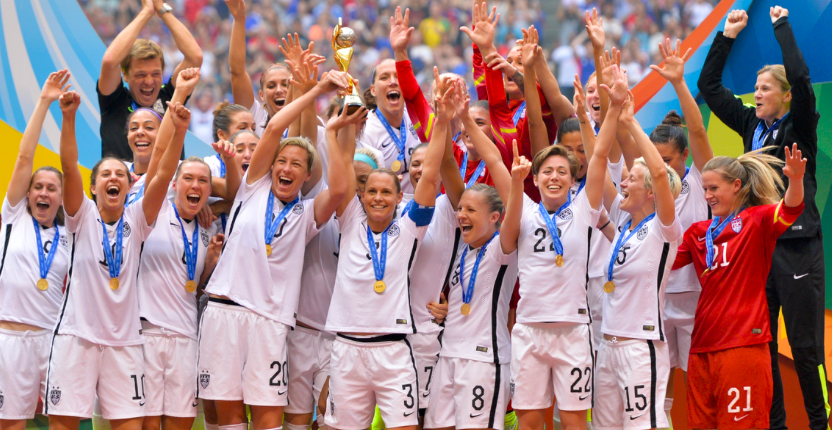
United States women’s soccer team, 2014 World Cup

The biggest problem women in professional sports are facing is the pay gap due to gender. The United States women’s soccer team, who has a better overall record than United States men’s soccer, received a reward of $2 million when they won the 2015 World Cup. On the other hand, the US men’s team who won the World Cup in 2014 was rewarded $35 million. That is a 33-million-dollar difference between the two, all because women do not get the same coverage as men. Makes me wonder, if women got more coverage would they close that 33-million-dollar gap? If they did get the coverage they deserve, would they even have more viewers? Or are people biased towards women in sports? 

That 33-million-dollar difference actually used to be more, so technically the gap has narrowed a bit more over recent years. In 2017 they are working towards making the prize money for the same sport for each gender equal. In 2017, 35 out of 44 professional sport are awarding the same amount of price money for each gender in that sport. People believe that women in 2017 are much more visible in sports than ever before. Honestly, I do not hear anything about women’s sports on social media or sports channels whatsoever. So, is that previous statement true? That statement was made in 2017, it is 2019 and I am still not hearing much about women’s sports in major sports media sites. Just because we are finally able to play the same sports professionally as men, does not mean we are getting paid the same. 

My final question is, if women did get the same coverage as men for their sporting events would they even see a significant amount of profit?

Citation: Perasso, V. (2017, October 3). 100 Women: is the gender pay gap in sport really closing? Retrieved from https://www.bbc.com/news/world-41685042

Equal Pay

For many many years women have been seen as inferior when in comes to men, especially in the work setting. Subconsciously women have probably always known that they are being underpaid when it comes to men in the exact same job. In the past 10 years the pay gap has been more researched, and fixed a little but only for certain jobs. Why on earth would women be paid less for the exact same job that their male counterpart is doing?

I read an article mostly about the NPF, National Pro Fastpitch league, and the MLB, Major League Baseball. The odd thing is that I had played softball for over 14 years of my life and have never heard of the NPF, that just tells you how much coverage they truly get. In the article I read it gave the average salary for each player for the MLB and the NPF per season. The NPF has a salary cap of $150,000 per team, which means thats $6,000 or less per player. Meanwhile, the average salary of and MLB player is around $4.7 million. I honestly am not surprised there is a gap, but I was absolutely shocked at these numbers.

Some part of me does understand that the reason that the MLB makes more money is because the amount of viewers and coverage. But, I do find it interesting that many people that watch softball actually find it much more entertaining than baseball, due to the fast pace and more competitive nature. So then why is the NPF still not getting the coverage they deserve? Should women even try to play professional sports or are they just wasting their time?

What Does it Take to Go Pro (As a Woman) ?

For many years professional sports have only consisted of men. The best shot women have at even somewhat going pro is the Olympics, and that’s a long shot. At least men have the options of minor leagues or going pro after college sports. Makes you wonder as a woman if going to college for a sport is even worth it.

Can we do it? Has professional sports just boiled down to which sport can make enough money? Will women ever be treated equally in any job field they decide to pursue? 

The women’s World Series for softball in 2018 had more viewers than the men’s 2018 baseball World Series. The reason people have started watching softball more than baseball is because softball is at a much faster pace. Usually the number one complaint while watching baseball is that it is too slow, which in turn makes it boring to watch. How many more years will it take with these viewing numbers before they consider a minor or major league for women’s softball? Or could women play alongside men in baseball? 

Plenty of professional sports have considered putting women into men’s sports. The ongoing trend with this though is that they would only want women playing certain positions. The NFL, National Football League, has considered letting women be punters or kickers. The MLB, Major League Baseball, has also considered letting women be pitchers. I find it interesting that even when they do consider putting women in to men’s professional sports that they are still limited to only certain positions. Is this the same way for other jobs that women will pursue? Can only a man do these certain jobs? Or can women do them just as well, but we’re not given the chance to do so. Where’s the fairness in that?